Posting a job on LinkedIn, Indeed or a niche job board feels like the obvious move when you need to hire. It is fast, familiar, and everyone does it. But the bills add up quickly, candidate data stays on their servers, and your employer brand gets buried under theirs. There is a less obvious but structurally stronger alternative: managing your job listings directly from WordPress, on your own site.
What job boards actually cost in 2025-2026
Before writing your job ad and deciding where to post it, it helps to have a clear picture of what the main platforms charge. The table below covers the key players in the French market, but the pricing logic applies across most European and international platforms.
| Platform | Free option | Paid listing | Model |
|---|---|---|---|
| France Travail | ✅ Yes | None | Free |
| Indeed | ✅ Limited | ~12€/day (sponsored) | Pay per click |
| LinkedIn Jobs | ✅ 1 active listing | ~220€/listing (pack) | Dynamic bidding |
| Monster | ❌ | From ~15€/day | Pay per click |
| HelloWork | ❌ | From ~99€/month | Subscription |
| Cadremploi | ❌ | ~870€ for 30 days | Flat fee |
| APEC | Partial | From ~450€/30 days | Flat fee |
| Welcome to the Jungle | ❌ | Quote-based, 1-year commitment | Annual subscription |
The numbers speak for themselves. A HelloWork subscription at 99€/month is 1,188€ per year, whether you hire anyone or not. Three LinkedIn listings at 220€ each is 660€ for a single hiring round. For a small business hiring two or three people a year, total spend can easily exceed 2,000 to 3,000 euros, with no guarantee of results and no ownership of the data collected.
So the question is worth asking: do you actually need these platforms to hire effectively?
The limits of job boards nobody talks about
Job boards are useful for reaching passive candidates or casting a wider net on an urgent hire. But they come with structural constraints that HR teams always end up feeling sooner or later.
You do not own your applications. CVs and conversations stay inside the platform. Stop paying and you lose access to your history. That data was never yours to keep.
You depend on each platform’s algorithm. Your listing’s visibility depends on your budget, the competition at that moment, and internal rules you have no control over, rules that change without notice.
You pay for every hire, indefinitely. There is no compounding effect. Each new listing starts from scratch, at the same cost as the last one.
Your employer brand lives on their turf. A candidate who finds your listing on LinkedIn sees LinkedIn first, not your company. Your brand identity gets diluted in the process.
Managing recruitment from WordPress: a serious alternative
If your site runs on WordPress, which is the case for 43% of websites worldwide, you already have the infrastructure to host a fully functional job management module.
The idea is not to abandon job boards overnight. It is to have a clean careers page on your own domain, with up-to-date listings, a built-in application form, and a centralised candidate tracking system inside WordPress, without depending on a third-party platform.
The practical benefits are real:
- Post as many listings as you want, with no extra cost per job ad.
- Applications come directly into your admin interface. You own all the data.
- Your careers page builds your employer brand on your own domain.
- If you still want to post on job boards for high-priority roles, you start from a solid base and control exactly how much you spend.
WP ATS Jobs Manager: a WordPress plugin built for job management
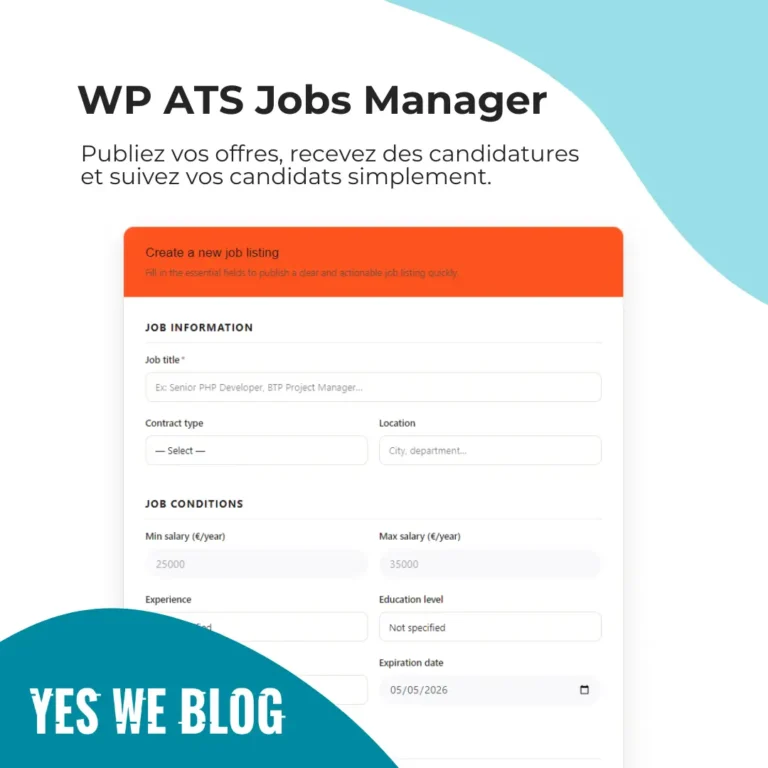
WP ATS Jobs Manager is a WordPress plugin built specifically for this. It lets you create, manage and display job listings directly from your WordPress dashboard, with no monthly subscription and no dependency on an external platform. One-time payment at 79€, unlimited listings, data stored on your server, updates included.
Here is what it does in practice:
- Live Ajax-filtered job listings with text search, contract type, location and remote work filters, no page reload needed.
- Application form with secure CV upload: files are stored locally in a protected directory, not accessible from the web. GDPR consent is recorded per application.
- Front-end recruiter dashboard: manage applications from the site itself, without going into the WordPress admin.
- 7 application statuses: New, Read, Contacted, Shortlisted, Interview, Hired, Rejected. Every candidate tracked without losing the thread.
- Automatic emails: confirmation to the candidate, notification to the recruiter, status change alerts.
- One-click CSV export of all applications.
- Automatic job expiry via WordPress cron. No outdated listings sitting live without manual cleanup.
- Customisable taxonomies from the admin panel, no code required.
Compatible with Gutenberg, Elementor, Divi, Blocksy, Kadence, Astra and all standard themes. Requires WordPress 6.0 and PHP 7.4 minimum. Available in French and English.
An SEO advantage job boards cannot give you
This is one of the least-mentioned benefits of hosting job listings on your own WordPress site: you become eligible for Google Jobs rich results.
WP ATS Jobs Manager automatically injects JSON-LD schema.org JobPosting markup on every published listing. In practice, this means your job ads can appear directly in the Google Jobs interface, with your company logo, location, contract type and expiry date, on the same level as listings from the major platforms.
When you post on LinkedIn or HelloWork, their domain gets the SEO benefit. When you post from your own WordPress, your site does.
Who is WP ATS Jobs Manager for?
The plugin is a strong fit for:
- Small and medium businesses that hire regularly and want to centralise applications without paying a monthly ATS subscription.
- Non-profits and associations with limited HR budgets that still need a reliable way to collect and track applications.
- WordPress freelancers and agencies managing client sites who want to integrate a job listings module directly into an existing setup.
- Any WordPress-powered site looking to cut down on third-party tools and SaaS subscriptions for something that can be handled in-house.
Job board or WordPress: does it have to be one or the other?
The two approaches work well together. Job boards are still useful for niche roles or reaching candidates who do not know your company yet. But relying on them exclusively is like renting a shopfront indefinitely instead of building one you actually own.
The most efficient setup for a small or mid-sized business: centralise job management on WordPress with WP ATS Jobs Manager, and use job boards selectively to boost visibility on priority roles, controlling both the budget and the duration.
Over time, this brings down the cost per hire significantly while building a consistent employer brand on your own site.
Beyond cost, the real question is about ownership: of your data, and of your employer image. Posting on a job board means renting visibility you lose the moment you stop paying. Managing recruitment from WordPress means building something that stays yours and gets better with each hire.
If you want to go further on the visual customisation side, there are WordPress themes built specifically for job boards, like Superio. The approach is different: the theme sets the overall structure, whereas WP ATS Jobs Manager fits into your existing theme.
WP ATS Jobs Manager: 79€, one-time payment, unlimited listings.
Application form, recruiter dashboard, automatic emails, Google Jobs markup, CSV export, GDPR-ready.
👉 Try the live demo | Get the plugin
Vous souhaitez voir Yes We Blog en priorité dans vos résultats Google ?